Cylinders
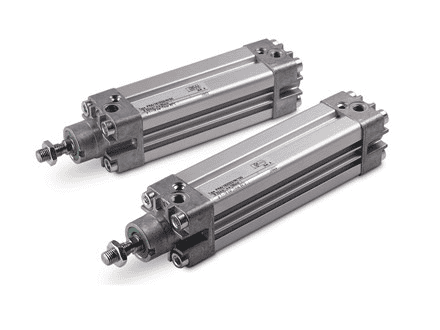
Enable Automation In Industrial Applications with Pneumatic Cylinders!
An act of moving the piston using compressed air that enters the pneumatic actuator, allowing different industrial applications to be automated. We, Goodwin, being engaged with reliable manufacturers, have easy access to high-quality pneumatic cylinders, ultimately making us the leading pneumatic equipment suppliers in the UAE. For precise and exact movement in pneumatic actuators, the compressed air movement can be controlled in terms of linear or rotary motion.
The compressed air movement pushing the piston forward is associated with linear motion, while the rotary movement is associated with rotary motion. One of the great features of using such types of actuators is their unmatched performance in an explosive environment, where electrical systems can’t be operated to stay protected from certain risks. Dampers and valves are thoroughly operated through such actuators in a precise manner, making them the right choice for heavy industries.
Here Are Two Types Of Pneumatic Cylinders!
Single-acting pneumatic cylinders
This type of pneumatic cylinder is the ideal choice for simpler tasks. The inclusion of compressed air allows the piston to move in one direction only, allowing it to perform certain tasks.
Double-acting pneumatic cylinders
Conversely, when compressed air leads to movement in both directions, this type of industrial pneumatic cylinder is associated with simplifying complex tasks in the UAE.
Get Along With The Benefits of Pneumatic Cylinders!
Industrial automation can be accelerated with the efficient use of pneumatic cylinders, making us the leading pneumatic actuator supplier in the UAE.
Includes quick operation
With the rapid movement of compressed air into the pneumatic cylinder, the entire task can be sped up, allowing the operator to achieve precise production outcomes.FRL unit suppliers in the UAE ensure they provide the FRL units in modular and integrated formats.
Safe and clean process
As there is no need to use hydraulic fluid or oil, only compressed air is used in the entire process, thus providing the operators with a clean working environment without any risk of leakage.
Cost-effective choice
Due to the inclusion of inexpensive materials and the use of available compressed air, these types of cylinders provide cost-effective solutions.
Best for repetitive tasks
Due to the inclusion of high reliability and durability in the pneumatic cylinders, different repetitive tasks such as operating heavy doors and gates are efficiently managed by these cylinders, without overheating the entire system.
Uncomplicated design
Due to the simple design of such cylinders, it is quite easy for the compressed air to move straight and efficiently without any interruption. For this reason, these can be maintained in an easy and simple manner, making them ideal for low maintenance.
Contact Us