
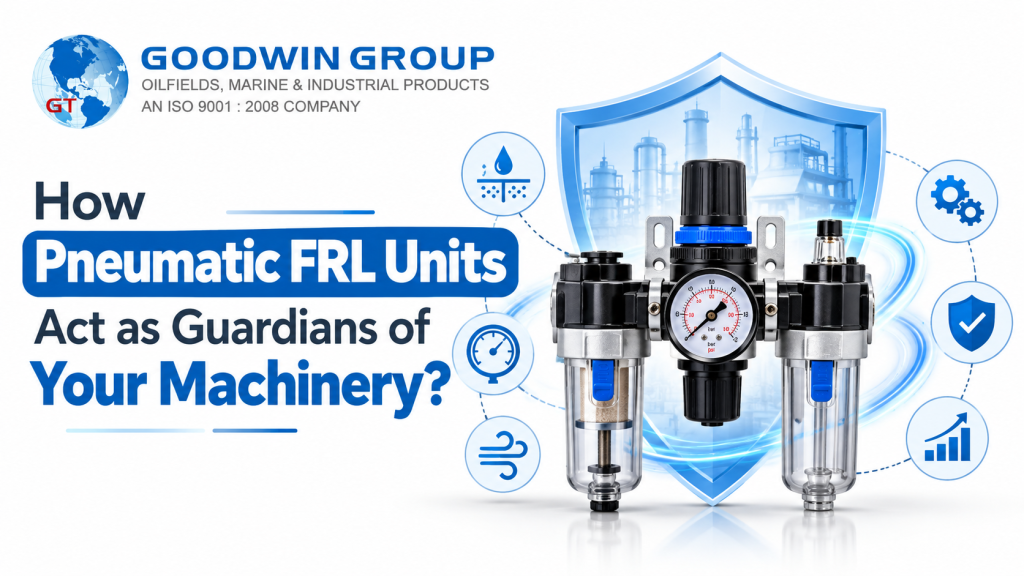
Securing sensitive cylinders, valves and tools in your industry from compressed air is crucial to increasing their lifespan. Setting up the Filter, Regulator and Lubricator in your industry before the control valves and after the machinery can play an imperative role in managing the compressed air. When the compressed air is not filtered out and regulated appropriately, it eventually results in tool wear, ruptured seals and costly production downtime. A complete FRL unit pneumatic system includes the management of compressed air with the purpose of filtering out dust and oil mist, along with thoroughly handling unstable temperatures. Further, this will help your machinery operate safely without getting damaged by dirty compressed air.
Welcome to this blog post where you’ll be introduced to the meaning of an FRL unit for your pneumatic systems, along with its importance for protecting your machinery in industry, so continue reading.
Understand the meaning of pneumatic FRL units!
It involves protecting pneumatic systems, such as valves and cylinders, from compressed air by removing oil mist and dust, regulating temperature and implementing an appropriate lubrication system. FRL units include a filter, regulator, and Lubricator, all utilized for managing the compressed air.
- By placing it before the control valves and after the air compressor units, the compressed air is thoroughly filtered by eliminating the oil mist and solid particles.
- The regulator included in this unit helps stabilize the upstream pressure with the purpose of providing an accurate temperature to the respective machinery.
- The inclusion of a lubricator in this unit significantly helps in the process of atomization of lubricating oil into fine particles, which further helps in injecting into the air stream.
Now understand the working of FRL units in pneumatic systems!
As mentioned above, the basic working of FRL units begins with filtration, followed by regulation and lubrication, eventually working as the control gate for the machinery.
- Air filtration process
- First and foremost, the compressed air enters the filter cup, which is then transferred into the swirling flow.
- As the compressed air contains moisture, dirt and solid particles, these are removed through centrifugal force.
- Through the filter element, even the tiny solid particles get filtered from the air.
- The liquid gets trapped and drains through the automatic drain valve eventually.
- Regulatory processes
- After filtration, the next crucial step involves the management of accurate temperature and pressure.
- This involves the use of a spring knob, which pushes down the diaphragm, resulting in the opening of the main valve for high-pressure air.
- After thoroughly balancing out the pressure, the diaphragm works by moving upward, eventually leading to the closing of the valve.
- The excess air is released when the diaphragm flexes upward and opens a relief port.
- Lubrication process
- This process includes the drop of lubricator over the compressed air that is flowing through the venturi tube.
- This process works as protection from corrosion, as it coats the internal parts of the pneumatic systems, such as cylinders, when the compressed air is passing through.
Why does a filter, regulator, and lubricator setup matter for pneumatic systems?
- The process of filtering the compressed air thoroughly helps in removing the debris and oil mist, allowing the sensitive components to run smoothly.
- With the inclusion of a regulator, it can be ensured that the equipment is protected from over-pressurization, along with accurate energy consumption.
- The lubrication process throughout the compressed airflow significantly helps in preventing friction and the internal parts from being worn down.
The Bottom Line!
Summing up the above-mentioned points, you might have understood the meaning of FRL in pneumatic systems, along with its working and importance. Understanding the precise functioning of such units for your pneumatic system can significantly help in preventing the wearing down of the equipment and costly repairs.
If you have been looking for exceptional quality FRL units, then here we are, Goodwin LLC, providing you with a vast range of instrumentation and pneumatics. Our experts have made sure to prepare such units with high-quality engineering solutions, thus giving one of the best outcomes.
FAQs
- Which oil would be best for use in the lubricator component?
Using specialized pneumatic tool oils, along with mineral and light oils, would be best for the lubricator component.
- Does a proper sequence of FRL units matter?
Yes, a proper sequence of FRL units matters in terms of letting the compressed air be filtered out, along with being regulated and lubricated to protect the pneumatic systems.
- Do all pneumatic systems need FRL units?
No, it is not necessary that all pneumatic systems need FRL units; however, basic regulation and lubrication are needed. Some pneumatic components are pre-lubricated and thus do not need FRL units; only FR (Filter and Regulator) setups are used.
- What does dropped pressure across FRL units indicate?
This indicates airflow restriction, along with the use of undersized components, resulting in a drop in pressure.
- What is the way of choosing the correct size of FRL unit?
Make sure to consider the airflow efficiency, as it should be higher than that of the downstream equipment. Along with this, a filtration level of 5 microns can be considered for the sensitive pneumatic system.